Hammonasset: let a nature-center question shape the shore walk
A beach day can begin with something to understand rather than a place to spread a towel. At Hammonasset, connect a modest shore visit with one question from Meigs Point Nature Center. This creates a flexible day for people who want coastal observation and conversation as much as time on the sand.
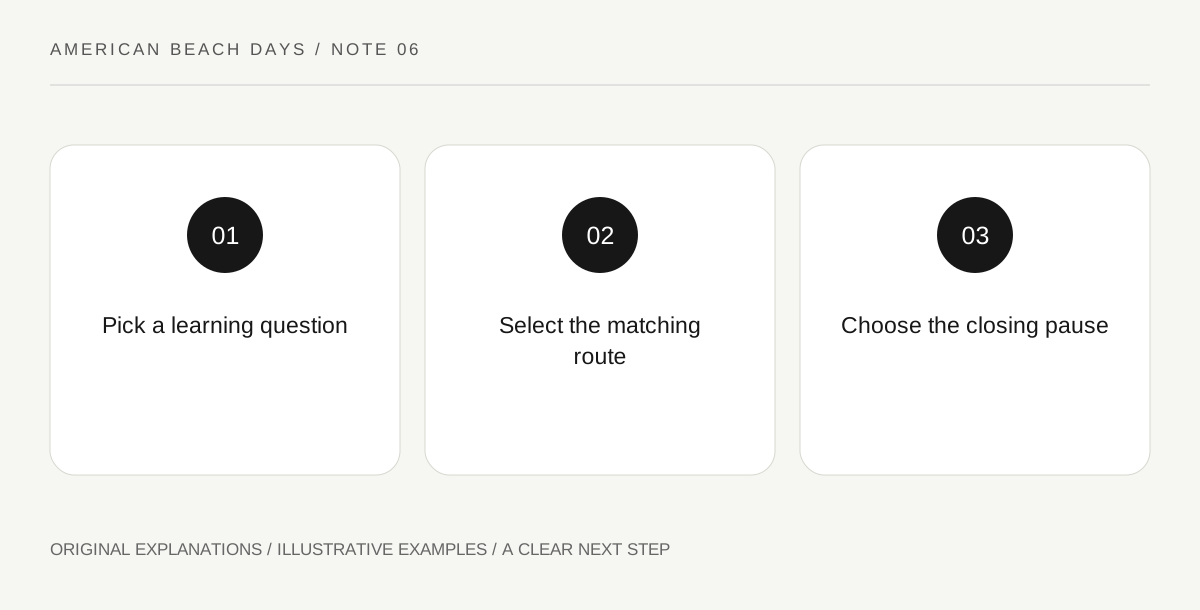
Original explanatory diagram. Read the full method and limitations below.
Choose the question before the route
Connecticut State Parks describes Meigs Point Nature Center’s exhibits on coastal habitats, animals and geology. Select one topic that interests the group, such as the relationship between the marsh and the shoreline. If the center is open for your date, use its interpretation to refine that question. If it is closed, consult official materials beforehand and choose an outdoor observation that stays on a permitted route. Do not make an unconfirmed exhibit the hidden foundation of the entire visit.
Match the path to the subject
The park distinguishes a paved coastal walk, Meigs Point Trail and Willard’s Island Nature Trail. Their names represent different routes and settings, not interchangeable versions of the same outing. Look at the current trail map and select the route that answers the question with a suitable distance and surface. An accessible description is a starting point for checking individual needs. Ask about the specific segment, any current obstruction and the transition between parking, interpretation and outdoor activity.
Make observation small enough to finish
A good assignment might be to notice where the view changes from open water to marsh, or to sketch the relationship of shore materials from a public path. Avoid turning a learning visit into a collection hunt or an attempt to touch wildlife. Give companions a way to participate without needing to identify every species. One careful observation can produce a better conversation than a list copied from an exhibit that nobody has time to connect with the landscape.
Keep the beach portion optional
After the chosen observation, decide whether to sit, picnic in a permitted place or return. A nature-centered day need not add swimming to count as a beach visit. If water activity is desired, make a separate decision using current water-quality information and posted controls. This separation also helps companions with different interests: they can agree on the learning activity without discovering that an assumed long beach session has been added to the itinerary afterward.
An illustrative beach-day decision
In an illustrative outing, a family chooses a marsh-and-shore question and confirms a nature-center visit. They then select one appropriate mapped outdoor segment, where each person describes one visible relationship. The planned sand pause is optional. When the group prefers a picnic instead, the day still has a clear purpose and conclusion. This invented sequence does not guarantee opening hours, trail conditions or a particular animal sighting.
Questions that come up
Must the outdoor walk start at the nature center?
No. That is one possible sequence. Use the actual map and the group’s needs to choose an arrival; the important link is between the question and the selected public route, not a required starting doorway.
Should everyone identify the same species?
No. Drawing a habitat boundary or describing a change in the view can be equally useful. Do not approach or disturb animals to force an identification or reproduce a picture from an exhibit.
References and scope
These sources support the factual background. Examples and exercises are original illustrative teaching material. References do not imply endorsement.
- Connecticut State Parks — Hammonasset — Meigs Point interpretation, mapped trails and beach access.