Head of the Meadow: decide whether the bicycle is transport or the main activity
A path connecting a parking area and a beach can serve two very different days. At Head of the Meadow, decide whether cycling is the outing itself or the way you reach a separate shore visit. That choice determines the starting point, the load and what must still be carried when the bicycle stops.
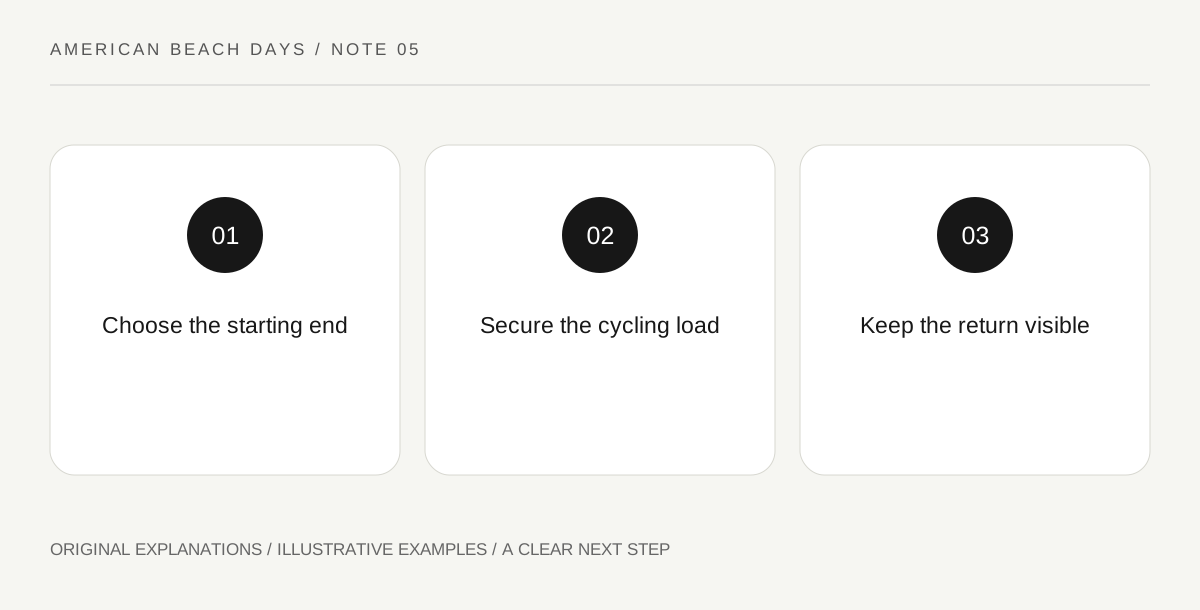
Original explanatory diagram. Read the full method and limitations below.
Understand the two ends
The National Park Service describes a two-mile paved trail linking High Head Road’s dirt parking area with Head of the Meadow Beach. A full return ride therefore covers four miles before any separate shore activity. Use the current trail map to identify both ends and choose your actual start. The beach parking area and the inland trail access are different destinations with different seasonal arrangements. A general beach pin does not communicate which one your companions should use.
Decide what the bicycle must carry
If the ride is the main activity, choose a load that stays secure and leaves the bicycle manageable. If the bicycle is transport to a longer beach stay, account for the belongings you will carry after parking it in an allowed place. A bulky beach chair that works beside a car may be awkward on this plan. Practice loading at home rather than discovering an unstable arrangement while standing beside other trail users at the starting point.
Read paved as a surface description
The park notes that the trail can have bumps, sand or standing water. Paving does not promise that every section will be smooth for every rider, adaptive cycle or mobility device on every date. Check current conditions and the dimensions that matter for your equipment. Follow the posted riding rules and share the route considerately. If the surface or a closure does not suit the group, change the activity rather than assuming the next section must improve.
Plan the pause and the return together
Seasonal restrooms at the beach end are useful to confirm before building a longer outing. Decide how long the shore pause should be and whether everyone wants the return ride afterward. Riding to a beach is not a one-way transfer unless you have made a separate, permitted arrangement. Keep the final leg visible in the plan so that people do not use all their energy or supplies on the outward journey and treat the return as an afterthought.
An illustrative beach-day decision
Imagine two riders starting at High Head Road with the cycle trail as their main purpose. They pack compact snacks, stop at the beach end only if access suits them and return along the same trail. Another group wanting several hours on the sand chooses direct permitted beach access instead. Both plans are invented examples; neither assumes open restrooms, current parking capacity or suitable surface conditions.
Questions that come up
Does the two-mile description include the return?
No. The operator describes a two-mile connection and a four-mile round trip. Any separate movement on the beach or beyond the trail adds to your own outing and should be considered separately.
Can a paved trail still be unsuitable for a particular device?
Yes. Surface conditions, width, handling and the person’s needs all matter. Ask the operator specific questions about the current route rather than treating one accessibility label as an individualized guarantee.
References and scope
These sources support the factual background. Examples and exercises are original illustrative teaching material. References do not imply endorsement.
- National Park Service — Head of the Meadow Bike Trail — Two-mile connection, two access points and seasonal beach facilities.