Yorktown Beach: check the whole access chain, not a single feature
One named piece of access equipment can be helpful without answering every question about a beach day. At Yorktown Beach, work through the journey from arrival to riverfront pause and back. That chain makes practical needs visible before an attractive description of a mat or chair becomes an assumed complete solution.
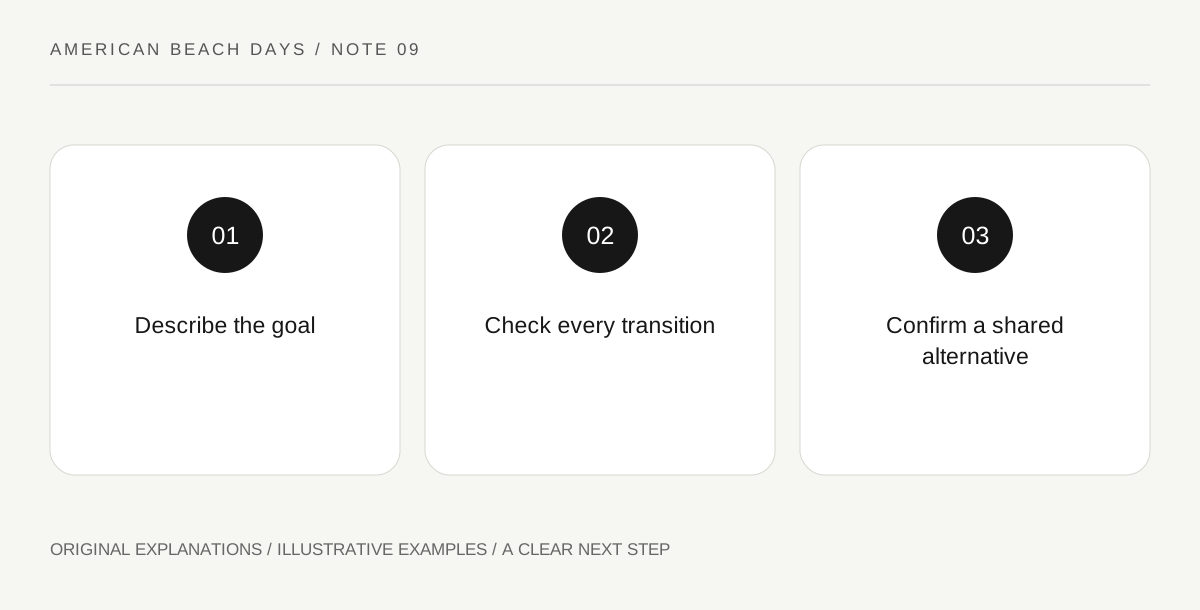
Original explanatory diagram. Read the full method and limitations below.
Begin with the person’s intended activity
Ask what the visitor wants to do: sit near the river, travel across sand, join companions at a public gathering place or participate in a separately assessed water activity. These goals require different information. York County describes Mobi-Mat and MobiChair arrangements, but a feature name does not establish that every goal is possible for every person. Record the actual desired experience first. Then ask the operator which parts of the route and assistance arrangement support it.
Describe each transition
Break the outing into the approach from permitted parking, the route to the beachfront, any transfer onto equipment and the return. Ask about surfaces, dimensions, slopes and the assistance relevant to the person’s device. Avoid requesting a vague assurance that the beach is accessible. Specific questions are easier for staff to answer accurately. If an equipment transfer is involved, the visitor and their support person should understand their own requirements; an article cannot assess a suitable personal transfer method.
Confirm the operational arrangement
Ask how equipment is requested, where it is collected, whether it is actually available for the date and what assistance or identification the current arrangement requires. Do not turn an older seasonal notice into a present-day reservation. Record who will make the final check and where the group will meet if equipment cannot be supplied. This keeps the plan collaborative rather than leaving the visitor to solve an unexpected access problem while everyone else has already settled on the beach.
Keep an equally social alternative
Design a riverfront gathering that includes the visitor even if the sand portion cannot happen. Choose a suitable public location only after checking its route and facilities. The alternative should preserve companionship and the intended view where possible, rather than assigning one person to wait alone. If a seasonal trolley or another transport service is considered, verify its own current route and access independently. A vehicle serving the wider waterfront is a separate part of the chain.
An illustrative beach-day decision
Imagine a visitor who wants to sit with friends beside the river but is unsure about crossing sand. The group asks the county about the exact route and current chair arrangement, then chooses a verified suitable public gathering alternative. One companion handles the final availability check; everyone knows the reunion place. This invented scenario demonstrates useful questions, not a guarantee of equipment, independent access or a safe transfer.
Questions that come up
Does a Mobi-Mat mean the entire beach is accessible?
No. Its location and reach are specific, and other transitions still matter. Ask about the route you intend to use and the requirements of the individual rather than extending a feature description to the whole site.
Can this article tell someone how to transfer into a chair?
No. The appropriate method depends on the person, equipment and support available. Discuss requirements with the operator and relevant qualified support before relying on a transfer as part of the outing.
References and scope
These sources support the factual background. Examples and exercises are original illustrative teaching material. References do not imply endorsement.
- York County — Yorktown Beach access — Riverfront beach, Mobi-Mat and assisted beach-chair arrangements; availability varies.