Asilomar: make a coast-trail notebook without collecting a souvenir
A beach notebook can preserve detail without removing anything from the beach. At Asilomar, combine a permitted coast-trail walk with a few drawings, photographs or written observations. The protected shore becomes the subject of the visit, while rocks, shells and wildlife remain part of the place where you noticed them.
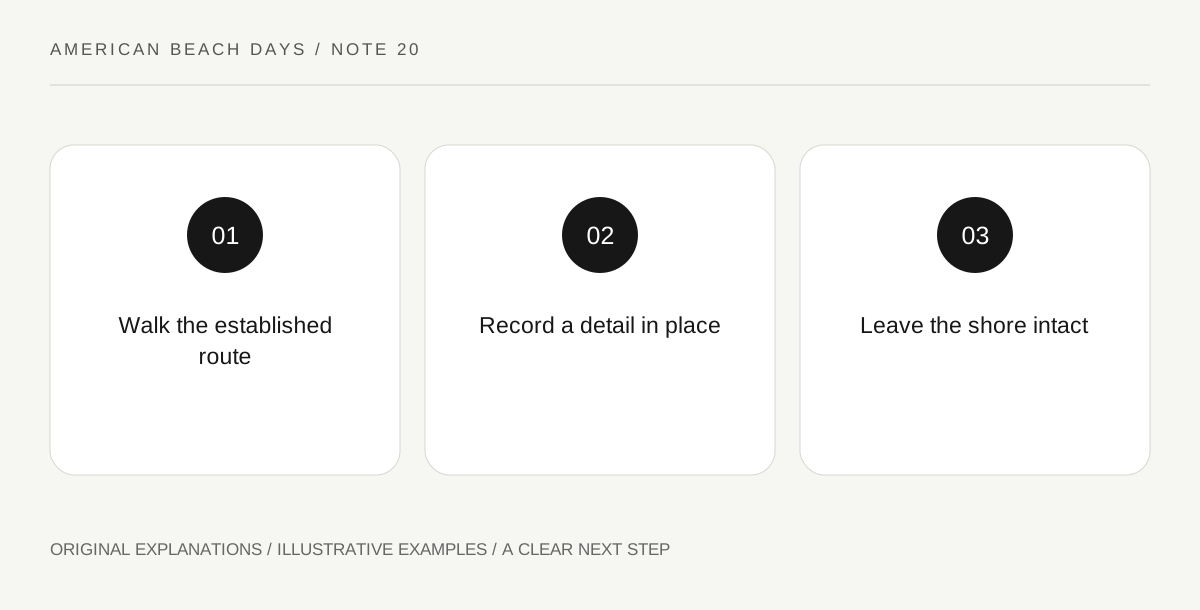
Original explanatory diagram. Read the full method and limitations below.
Use the established coastal route
California State Parks describes the Asilomar Coast Trail and its boardwalk sections and asks visitors to stay on established routes and out of posted areas. Start with a manageable open portion appropriate to the group. Do not treat the approximate overall length as a requirement to cover every section. Identify where you intend to turn and how you will return. A short observation made from a permitted route is better aligned with the place than an ambitious circuit through a closed or fragile area.
Choose a detail you can record in place
Look for a relationship visible from your authorized position: the shape of the horizon against rocks, a change in color or the way the public route passes beside the landscape. Sketch the outline or describe it in your own words. Do not move natural material to improve a picture or touch wildlife to inspect it. The notebook’s purpose is attention, not a specimen collection, so an imperfect drawing can be a more faithful souvenir than a removed object.
Understand the reserve boundary of behavior
The state park explains that Asilomar State Beach lies within the marine reserve and specifically prohibits collecting natural features such as rocks, shells and sand, as well as disturbing wildlife. Apply that rule to the small object as well as the obviously living animal. A loose shell is not automatically available to take. Follow current signs and reserve information for the actual place. Photography and notes should remain within those controls rather than being used as reasons to rearrange the shore.
Keep the record personal and modest
Give each companion one small task: a line drawing, three colors described in words or a sentence about the view from a public pause. Share the results after returning rather than crowding a narrow route while everyone edits photographs. Do not force the same image on every person or pursue a closer position to match an online scene. The record can show what this group could observe from its chosen permitted route on this particular outing.
An illustrative beach-day decision
In an invented afternoon plan, two friends select an open trail segment and each record one visible detail without leaving the established route. One sketches a rock outline; the other writes a brief description of the horizon. They leave shells and sand in place and compare their notes afterward. This example does not establish current trail opening, wildlife presence or suitable conditions for any water or intertidal activity.
Questions that come up
May an empty shell be taken because it is not alive?
The park’s reserve guidance prohibits collecting natural features, including shells, rocks and sand. Do not treat an apparently empty object as an exception; follow current official rules and leave it in place.
Must a coast notebook contain accurate species names?
No. A careful description of what is visible can be useful without identification. Do not handle wildlife or move closer through restricted areas to force a name or improve the apparent completeness of a note.
References and scope
These sources support the factual background. Examples and exercises are original illustrative teaching material. References do not imply endorsement.
- California State Parks — Asilomar Coast Trail — Coast trail, boardwalk and protected habitat; keep to established routes.
- California State Parks — Asilomar Marine Reserve — Reserve restrictions on collecting and disturbing wildlife.