Kohler-Andrae: build a shared beach pause around participation
A group beach plan works best when everyone can participate in its main moment. Kohler-Andrae State Park lists accessible recreation features and beach-chair information. Use those details to ask precise questions, then build the shared pause around the whole group’s route rather than attaching access as a last-minute extra.
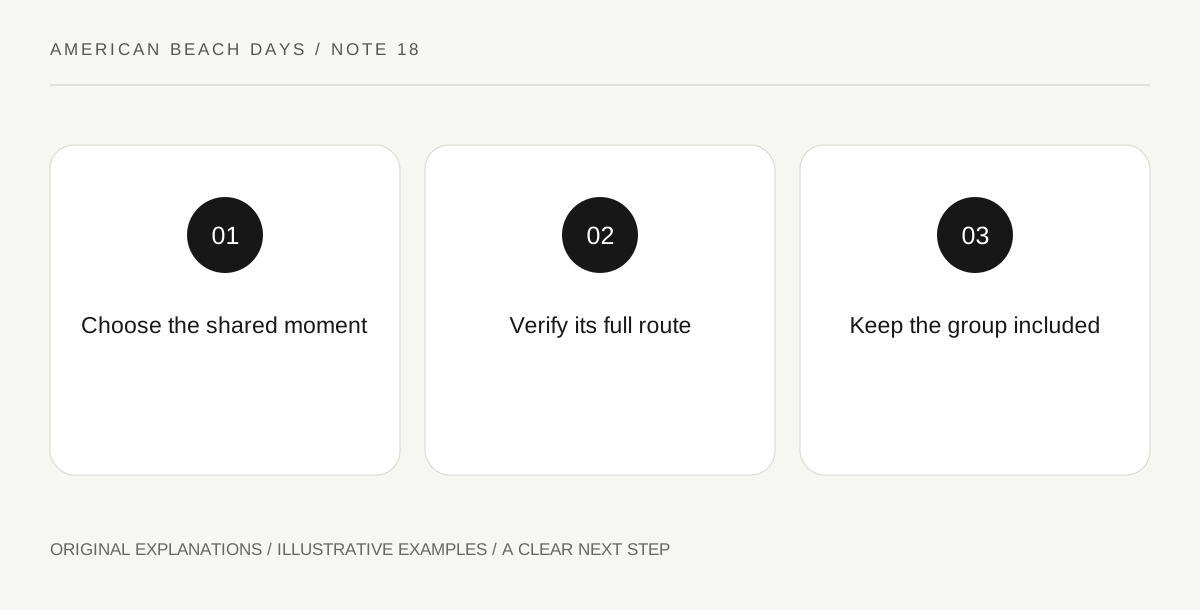
Original explanatory diagram. Read the full method and limitations below.
Define the shared moment
Decide what everyone wants to do together: enjoy a lake view, have a permitted picnic, visit interpretation or reach a particular part of the shore. Wisconsin’s recreation page lists an accessible beach picnic site, nature center and other features, but these are distinct places. Choose the shared activity before requesting details about a route. This helps the operator understand the real question and prevents an equipment enquiry from substituting for a discussion about the day’s purpose.
Check the connection between listed features
A collection of accessible icons does not describe every transition linking them. Ask about the actual public approach, surfaces, parking and any segment between the chosen picnic or interpretation area and the desired shore position. Consider the person’s own device and support requirements. Where an accessible trail is proposed, identify the specific route rather than asking about all trails at once. A clear chain of places is more useful than a general assurance that the park has opportunities for everyone.
Confirm the chair arrangement directly
The DNR says the park has beach wheelchairs and asks visitors to call for details. Ask about current availability, collection, handling and the assistance relevant to your plan. Do not assume a device is reserved, self-propelled or suitable for every individual merely because it is listed. If a transfer is involved, understand the person’s requirements with appropriate support. The article can organize questions, but it cannot prescribe a transfer technique or decide whether a particular device meets someone’s needs.
Make the alternative preserve the gathering
If the sand portion cannot work, choose a verified suitable public activity where the group can remain together. A lake-view picnic or an open interpretation visit may meet the original purpose, depending on the actual route and facilities. Do not turn one person’s changed access into an instruction to wait separately while everyone else has the main experience. Agree on the alternative before departure and pack for it, so that a service problem changes the location rather than the person’s inclusion.
An illustrative beach-day decision
In an illustrative group plan, the shared goal is lunch beside a lake view. One companion asks about the exact picnic approach and the current chair arrangement. The group also checks a suitable alternative gathering place, giving it the same social importance. They do not promise a sand transfer until the necessary details are understood. This invented scenario does not reserve equipment or assess an individual’s personal access needs.
Questions that come up
Does the listed number of beach chairs guarantee one on arrival?
No. Contact the property about current availability and its actual request process. A general equipment listing is not a reservation or a statement about the condition and suitability of a particular chair.
Should a nature-center visit be the automatic alternative?
Only if it interests the group and its opening and route fit the visitor’s needs. Choose the alternative from the shared purpose and verify it rather than assigning it solely because it sounds accessible.
References and scope
These sources support the factual background. Examples and exercises are original illustrative teaching material. References do not imply endorsement.
- Wisconsin DNR — Kohler-Andrae recreation — Lake Michigan recreation, dunes, trails and nature interpretation.