Grand Isle: let the lagoon give the beach day a second perspective
A coastal visit can be more interesting when the shore is understood as part of a wider landscape. At Grand Isle State Park, consider one modest lagoon-side observation alongside a permitted beach pause. The aim is a change in perspective, not an attempt to turn every bird, channel and stretch of sand into another activity.
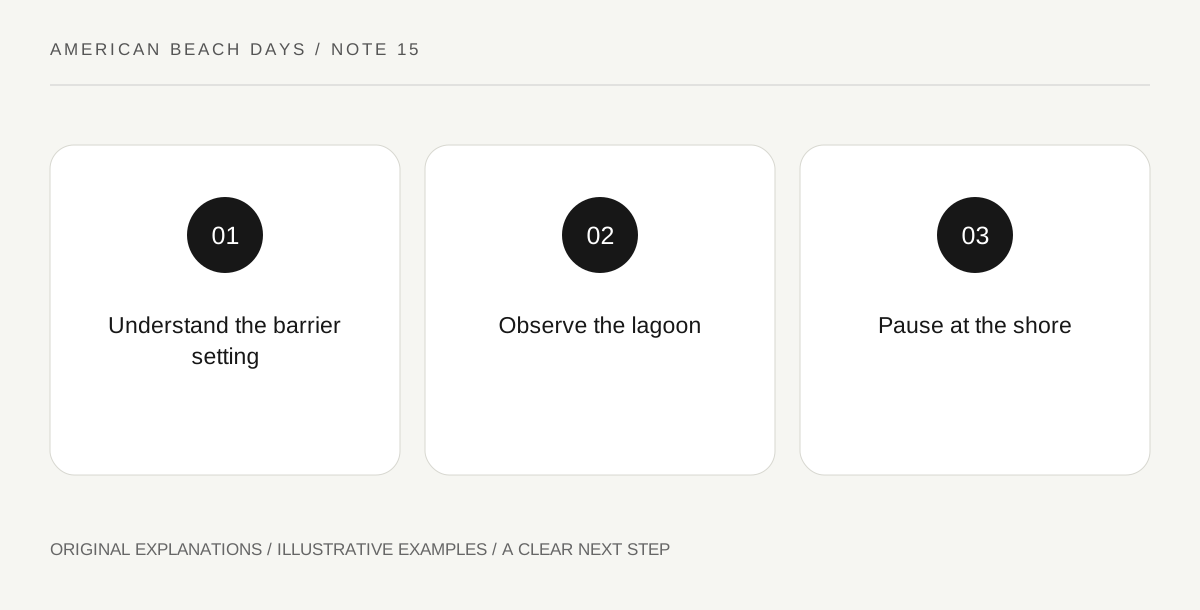
Original explanatory diagram. Read the full method and limitations below.
Read the island’s position
Louisiana State Parks describes Grand Isle as a barrier ridge between the Gulf and inland channels and points visitors toward lagoon birding. Use that relationship to understand the place before choosing where to spend time. Mark the actual public access for each selected stop on the current map. A landscape description does not authorize entering every water edge or vegetated area. The useful plan connects a small number of permitted places from which the relationship can be seen.
Choose a patient observation
Instead of promising a named bird sighting, give the group a question that can be answered even when wildlife stays distant: how does the lagoon setting differ from the open shore? Look at the visible water, vegetation and horizon from authorized access. A notebook sketch or a spoken comparison needs little equipment and does not depend on a rare animal appearing. Keep enough distance to avoid disturbing wildlife; better observation often comes from staying still rather than repeatedly approaching.
Make the beach pause complement it
After the observation, choose a suitable permitted shore activity that feels different, such as sitting, a modest walk or a picnic where allowed. Do not assume that the lagoon and beach can be linked by an informal shortcut. Use the current map and posted routes. If someone needs a specific access feature or beach chair, ask the park about the actual arrangement and availability before relying on it. A listed device is useful information, not a personal access assessment.
Treat the road approach as part of planning
Check current state and park information for the route you will use, including any bridge or toll arrangement relevant to the vehicle. Keep navigation and payment questions separate from the time intended for the actual visit. Avoid copying an old price or route assumption into the itinerary. At the end, return along the planned public approach and leave the landscape undisturbed. The day’s record can be a comparison and a drawing rather than something taken from the shore.
An illustrative beach-day decision
Imagine a couple planning one lagoon observation and a short beach pause. They select two mapped public locations and keep the change between them explicit. Their notebook asks for three differences in the view, so the activity remains worthwhile without a particular bird sighting. They check the road approach independently. This invented example does not guarantee wildlife, facilities, beach-chair availability or present road conditions.
Questions that come up
Is the lagoon a swimming alternative to the Gulf?
This plan makes no such recommendation. The observation setting and any water activity are separate questions. Follow the current operator’s designated-use and safety guidance for the actual place.
Should a birding day aim for a species total?
It can, but a small landscape comparison is often more flexible for a mixed-interest group. Do not approach wildlife or leave permitted routes to obtain a number or rescue an expected sighting.
References and scope
These sources support the factual background. Examples and exercises are original illustrative teaching material. References do not imply endorsement.
- Louisiana State Parks — Grand Isle — Barrier-ridge setting, lagoon birding and beach access information.