Ship Island: put the return plan on paper before leaving the mainland
A boat-served beach day needs a return plan that remains understandable when a phone has little signal. The National Park Service describes extremely limited cellular reception on Ship Island. Prepare the transfer, the island activity and the reunion arrangement before the group leaves the mainland, while questions are still easy to resolve.
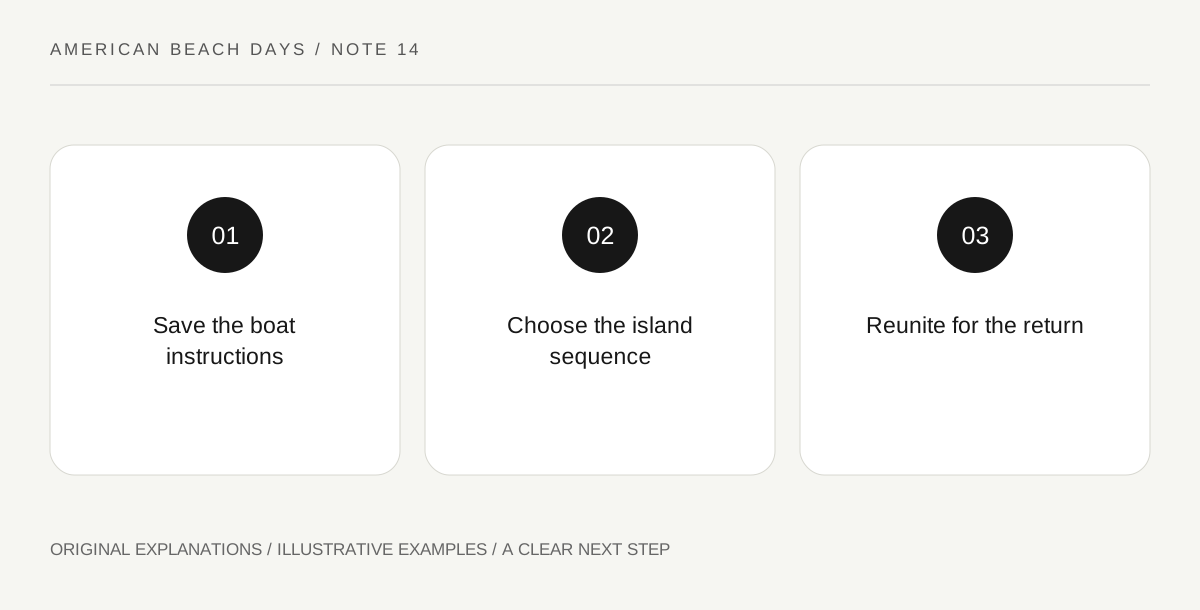
Original explanatory diagram. Read the full method and limitations below.
Make the mainland departure a specific place
The park identifies passenger ferry access from Gulfport and publishes information about seasonal service. Confirm the current operator’s actual departure and arrival instructions for your booking. Save the address, meeting requirement and return information outside a live web connection. A reservation email is useful, but make sure the essential details can be read when data is unavailable. If companions travel separately, share the exact departure location rather than merely telling them to meet at the coast.
Choose a shore and fort balance
Ship Island has a beach setting and Fort Massachusetts interpretation. Select a main interest and check the current availability of the other before combining them. A fort visit has its own opening and program arrangements; it is not guaranteed by reaching the island. Consider the walking and carrying involved between the permitted places you choose. The park advises walking shoes and notes that there is no public transportation on the island, so a casual list of attractions can conceal the movement connecting them.
Keep the group’s information offline
Write the agreed meeting landmark, return instructions and a simple activity sequence in the notebook. Give more than one adult access to those details so that a single phone is not the group’s only reference. Do not plan to solve a missing return detail through a last-minute signal search. Before anyone separates for interpretation or a shore pause, make the next reunion unambiguous. Information should help people move calmly, not encourage leaving permitted areas to find reception.
Leave enough flexibility for the boat connection
Organize the last activity around the actual operator’s return requirements, including the walk back and any check-in instruction. Do not use an invented universal buffer or assume every advertised sailing operates on every date. Bring the supplies needed for the booked outing within current baggage rules and check what services are available. If the transfer is unsuitable or cancelled, use a separately chosen mainland day rather than treating another boat arrangement as automatically equivalent.
An illustrative beach-day decision
For an illustrative visit, two companions save the booking instructions offline and write their return details on a small card. They choose one main beach pause and add a fort visit only if the current opening fits. Before separating briefly, they agree on a public reunion point and the next movement. This invented example is about information design; it does not confirm ferry operation, building access or a safe water activity.
Questions that come up
Can the return time be checked after reaching the island?
It should already be clear before departure. Limited reception makes a live lookup unreliable, and the booking operator’s current instructions should govern the actual return arrangement.
Does a boat ticket include an open fort program?
Do not assume so. Transport and interpretation are separate arrangements. Check the current park and operator information and let the beach visit work without a particular building or program if that remains suitable.
References and scope
These sources support the factual background. Examples and exercises are original illustrative teaching material. References do not imply endorsement.
- National Park Service — Ship Island — Boat-only access, limited cellular reception, fort and beach planning.